

Overthinking is exhausting. If you constantly replay conversations, imagine worst-case scenarios, or struggle to switch off your thoughts at night, you may often ask yourself why overthinking happens in the first place. Although many people believe overthinking is a personality flaw, it is actually a mental pattern rooted in fear, uncertainty, and unconscious habits.
In this guide, we will explore why overthinking happens, how it affects your emotional well-being, and most importantly, how awareness reduces overthinking in a practical and sustainable way. Instead of offering quick motivational fixes, this article provides grounded psychological insight combined with conscious living principles.
What Is Overthinking and Why It Feels Uncontrollable?
Overthinking occurs when the mind becomes trapped in repetitive thought loops. Instead of solving a problem, the brain replays it repeatedly. As a result, clarity decreases while anxiety increases.
For example, you may analyze a simple conversation for hours. You may also predict negative outcomes without evidence. Consequently, your body reacts as if danger is real, even though the threat exists only in thought.
Overthinking often appears in three common forms:
- Rumination about the past
- Worry about the future
- Self-criticism in the present
Although these patterns feel automatic, they are learned mental habits. Therefore, understanding why overthinking happens is the first step toward change.
Why Overthinking Happens
1. A Major Reason Why Overthinking Happens Is the Need for Control
The human brain evolved to detect threats. In uncertain situations, it tries to regain control by thinking more. However, thinking more does not always mean thinking clearly. Instead, the mind attempts to predict every possible outcome.
Because uncertainty feels unsafe, overthinking temporarily creates the illusion of preparation. Nevertheless, this habit often increases stress rather than reducing it.
2. Fear of Failure as a Cause of Overthinking
Many overthinkers struggle with perfectionism. They believe that if they analyze every angle, they can avoid failure. While preparation is useful, excessive mental rehearsal leads to paralysis.
As a result, decisions feel overwhelming. Instead of acting confidently, the mind searches for more certainty, which rarely arrives.
3. Emotional Suppression as a Trigger for Repetitive Thinking
Unprocessed emotions frequently trigger overthinking. When you avoid feeling sadness, anger, or insecurity, those emotions transform into mental noise. Therefore, the mind keeps circling the issue without resolution.
For instance, if you feel rejected but do not acknowledge the hurt, your thoughts may replay the event repeatedly. Consequently, overthinking becomes a substitute for emotional processing.
4. Conditioned Mental Patterns That Make Overthinking Happen
Overthinking is often a conditioned response. If you grew up in an environment where mistakes were criticized or uncertainty felt dangerous, your nervous system may have learned to stay hyper-alert.
Over time, this alertness becomes your default mode. Thus, the mind scans constantly for potential problems.
Why Overthinking Happens and Its Hidden Emotional Costs
Although thinking feels productive, chronic overthinking drains energy. It affects multiple areas of life.
First, it reduces sleep quality. When thoughts intensify at night, relaxation becomes difficult. Second, it weakens decision-making because every option feels risky. Third, it damages relationships because imagined scenarios replace direct communication.
Moreover, overthinking increases anxiety symptoms. The body reacts to imagined threats with real stress hormones. Consequently, tension builds physically as well as mentally.
Therefore, addressing overthinking is not merely about improving focus. It is about protecting emotional well-being.
Why Overthinking Happens vs Awareness: Understanding the Difference
Many people confuse awareness with thinking. However, awareness is fundamentally different from mental analysis.
Overthinking involves being lost inside thoughts. Awareness, in contrast, involves observing thoughts.
When you overthink, you become the thought. When you practice awareness, you notice the thought.
This distinction changes everything.
For example, instead of saying, “I am failing,” awareness allows you to say, “I am noticing a fear of failure.” Although the difference seems subtle, it creates psychological space.
Because awareness separates you from the thought, it reduces emotional intensity. Consequently, clarity increases naturally.
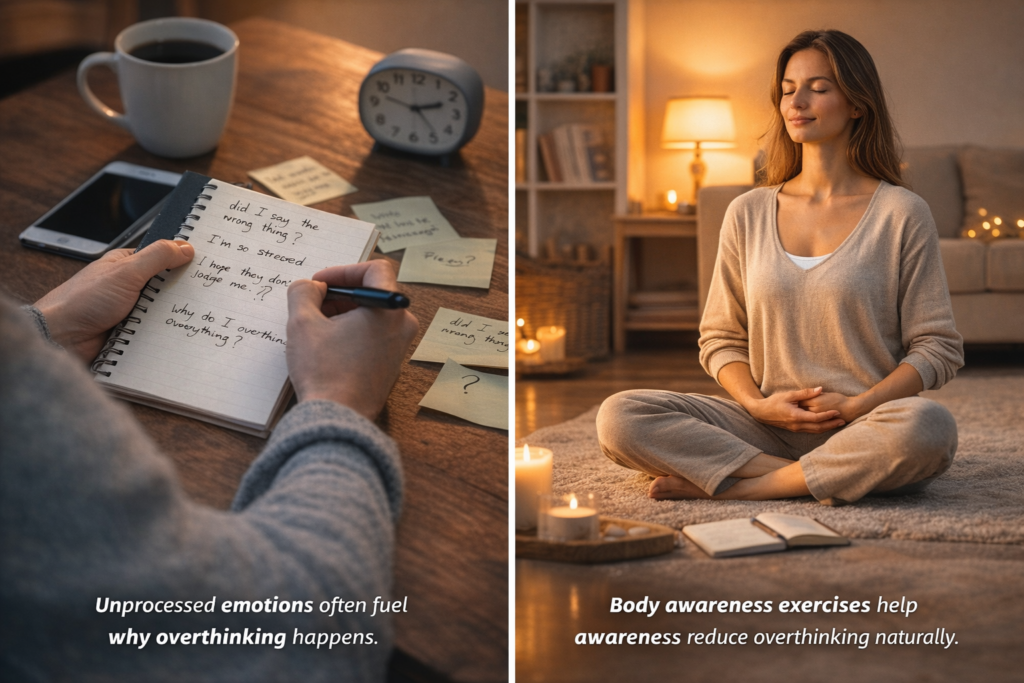
How Awareness Reduces Overthinking and Interrupts Mental Loops
1. Interrupting the Mental Loops Behind Overthinking
Awareness acts as a mental pause button. When you notice repetitive thinking, you interrupt the pattern. Instead of continuing the loop, you create a moment of observation.
Even a brief pause shifts brain activity away from emotional reactivity. Therefore, awareness weakens the automatic cycle of rumination.
2. Bringing Attention to the Present to Stop Overthinking
Overthinking usually lives in the past or future. Awareness, however, exists in the present moment.
By focusing on breathing, body sensations, or immediate surroundings, you anchor attention. As a result, mental projections lose intensity.
The present moment does not contain imagined disasters. Thus, grounding reduces unnecessary anxiety.
Building awareness through conscious living helps individuals respond thoughtfully rather than react automatically.
3. Processing Emotions Instead of Overanalyzing Them
When you practice awareness, you begin noticing underlying emotions. Instead of analyzing endlessly, you ask, “What am I actually feeling?”
Often, beneath overthinking lies fear, insecurity, or sadness. Once acknowledged, these emotions soften. Consequently, the need for repetitive thought decreases.
4. Building Flexibility to Reduce Repetitive Thoughts
Regular awareness practice strengthens mental flexibility. Rather than reacting automatically, you gain choice.
You can choose to continue thinking or redirect attention. Over time, this flexibility reduces compulsive analysis.
Practical Exercises to Reduce Overthinking
Understanding theory helps. However, consistent practice creates change. The following techniques combine psychological research with awareness principles.
1. The Three-Breath Reset to Calm Overthinking
Whenever you notice overthinking, pause. Take three slow breaths. During each breath, focus entirely on the physical sensation of inhaling and exhaling.
Although simple, this resets the nervous system. Moreover, it interrupts thought momentum.
2. Labeling Thoughts to Understand Why Overthinking Happens
Instead of engaging with content, label the category:
- “Future worry”
- “Past replay”
- “Self-criticism”
Labeling activates rational brain regions. Consequently, emotional intensity decreases.
3. Scheduling Worry Time to Control Repetitive Thinking
If your mind insists on worrying, assign a 15-minute window daily. During that time, write concerns down. Outside that window, gently postpone them.
This method trains the brain that worry has boundaries.
4. Body Awareness to Reduce Mental Overload
Close your eyes and scan your body from head to toe. Notice tension without trying to fix it.
Often, overthinking is stored physically. Therefore, releasing body tension reduces mental noise.
Many teachings on awareness emphasize observing thoughts without attachment or judgment.
5. Limiting Information Overload to Prevent Overthinking
Constant social media exposure increases comparison and uncertainty. Consequently, overthinking intensifies.
Reducing digital stimulation supports mental clarity.
Why Quick Fixes Fail
Many people search for how to stop overthinking instantly. However, quick fixes rarely work long-term. Overthinking has developed over the years. Therefore, patient retraining is required.
Motivational quotes may inspire temporarily. Yet without awareness practice, patterns return. Instead of forcing positivity, build consistent mental observation skills.
Progress may feel slow initially. Nevertheless, small daily awareness shifts create lasting transformation.
Why Overthinking Happens and When It Becomes Anxiety

Sometimes overthinking connects to clinical anxiety. If thoughts feel uncontrollable or severely impact daily life, professional support may help. Overthinking often develops when awareness is weak and mental habits dominate daily life.
Awareness complements therapy but does not replace medical care when needed. Therefore, seeking support reflects strength rather than weakness.
According to research from the American Psychological Association, persistent rumination can contribute to anxiety and emotional distress.
Long-Term Benefits of Awareness for Chronic Overthinking
As awareness strengthens, several changes occur:
- Emotional regulation improves
- Decision-making becomes clearer
- Sleep quality increases
- Relationships feel more authentic
- Self-criticism softens
Most importantly, your identity shifts. Instead of identifying as “an overthinker,” you become someone capable of observing thoughts without being controlled by them.
Conclusion: From Overthinking to Clarity
Understanding why overthinking happens reveals that it is not a personal defect. Rather, it is a protective strategy that became excessive.
However, protection through constant analysis often creates more stress than safety. Therefore, awareness provides a healthier alternative.
By observing thoughts instead of merging with them, you create psychological space. In that space, clarity grows naturally.
Overthinking may not disappear overnight. Nevertheless, through consistent awareness practice, it gradually loses intensity. With patience, you can shift from mental chaos toward conscious clarity.
Frequently Asked Questions About Overthinking
Overthinking happens because the brain is wired to detect potential threats. Even when there is no immediate danger, the mind may search for problems to solve. As a result, it creates hypothetical scenarios. Awareness helps interrupt this habit by bringing attention back to the present moment.
Overthinking itself is not a mental disorder. However, chronic rumination can be linked to anxiety or stress-related conditions. If repetitive thinking feels uncontrollable or affects daily life, professional support may be helpful.
Overthinking intensifies at night because external distractions decrease. Therefore, mental activity becomes more noticeable. Practicing slow breathing, journaling before sleep, and limiting screen exposure can reduce nighttime rumination.
Yes. Awareness reduces overthinking by creating distance between you and your thoughts. Instead of becoming absorbed in mental loops, you observe them. Consequently, emotional intensity decreases and clarity improves.
Small situations often trigger deeper insecurities or fear of judgment. Although the situation appears minor, the emotional reaction may connect to past experiences. Awareness helps identify the underlying emotion rather than analyzing the event repeatedly.
In many cases, yes. Perfectionism increases the fear of making mistakes. Therefore, the mind keeps analyzing decisions to avoid failure. However, excessive analysis often leads to mental exhaustion rather than improvement.

Pingback: What Is the Ego? A Simple Explanation for Modern Minds
Pingback: Ego in Relationships: How It Destroys Love and How to Fix It
Pingback: Meditation for Beginners: How to Start When Your Mind Won’t Stop Thinking
Pingback: Why We Chase People Who Don’t Love Us Back