
Introduction
What is the ego, and why does it influence so many of our emotional reactions?
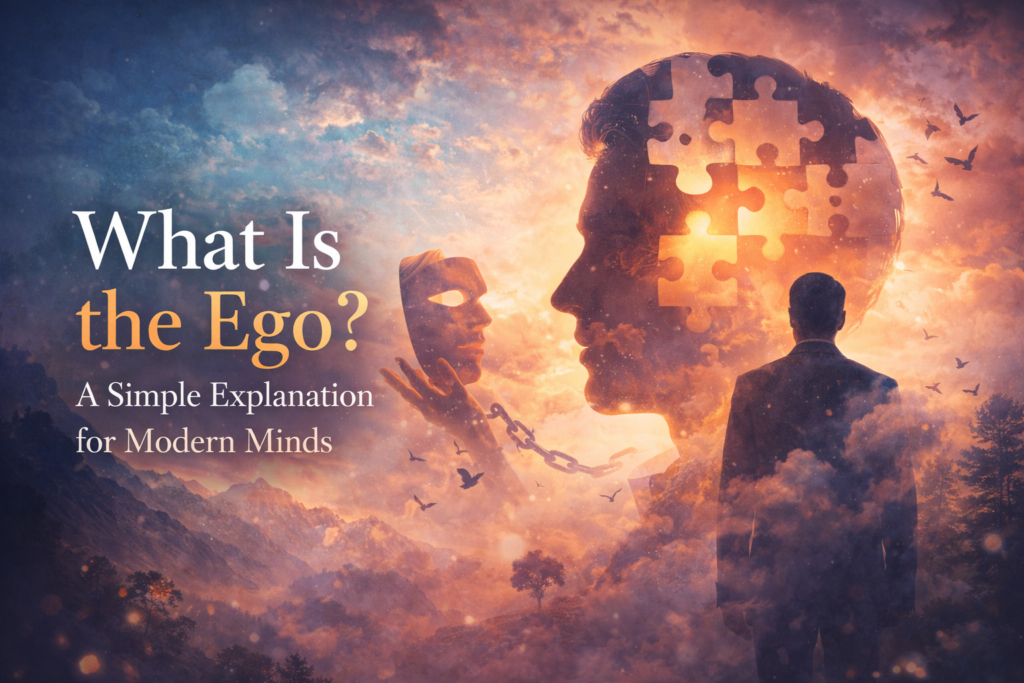
Although the term is often linked to arrogance, its meaning is more subtle. It refers to the self-image we construct over time — the internal story about who we are. This mental identity shapes how we respond to praise, criticism, rejection, and comparison.
Understanding this psychological structure helps explain why certain situations trigger strong emotional responses. Therefore, this guide breaks the concept down in a practical and modern way.
The Basic Meaning of the Ego
In everyday language, it refers to the image you hold about yourself.
This includes:
- Your roles
- Your achievements
- Your opinions
- Your beliefs
- Your social position
Together, these elements form a self-concept. Over time, you begin to protect this identity because it feels like “you.”
However, this sense of self is shaped by memory, experience, and external feedback. It is not your entire being — it is a constructed layer of identity.
How the Ego Develops in Childhood and Society
Your internal image begins developing in childhood.
When a child repeatedly hears labels such as:
For example, a child may repeatedly hear phrases such as “You are smart,” “You are shy,” or even “You are difficult.” Over time, these labels begin to shape self-perception. As a result, identity slowly forms around repeated descriptions.
Those descriptions slowly become internalized beliefs.
Later, comparison strengthens this structure. School, career competition, and social environments reinforce the need to define oneself in relation to others.
Eventually, people become attached to the version of themselves they present to the world. That attachment is where emotional defensiveness begins.
Ego vs Identity: Understanding the Difference
There is an important distinction between having an identity and clinging to it.
Identity is simply how you describe yourself.
Attachment occurs when you feel threatened if that description is challenged.
For example, if you see yourself as intelligent, disagreement may feel uncomfortable. The discomfort does not come from facts — it comes from protecting your self-image.
The stronger the attachment, the stronger the emotional reaction.
How the Ego Affects Relationships
Many relationship conflicts are not about the issue itself. Instead, they arise from identity protection.
When someone disagrees with you, it may feel like rejection. Similarly, jealousy often reflects fear of losing importance.
The need for validation can silently influence conversations. Rather than listening openly, individuals may focus on defending their position.
If you have read our article on awareness and overthinking, you may recognize how defensive reactions can trigger repetitive mental loops.
Recognizing these patterns reduces unnecessary tension.
Emotional Triggers and Defensive Reactions
Certain comments hurt more than others. This usually indicates sensitivity in a specific area of your self-concept.
For instance:
- Criticism may activate insecurity.
- Rejection may trigger fear of inadequacy.
- Comparison may awaken feelings of inferiority.
These responses are not random. They are linked to beliefs about who you think you must be.
Instead of reacting immediately, pause and ask:
“What belief about myself feels threatened?”
This question creates space for awareness.
Practicing conscious living strengthens the ability to observe these reactions calmly.
A Psychological Perspective
In psychology, this structure is described as the part of the mind that mediates between instinct and social reality. According to the American Psychological Association (APA), it helps individuals function within societal expectations.
While this function is necessary, problems arise when identity becomes rigid.
Flexibility allows growth. Rigidity creates conflict.
Signs of Over-Identification
You may notice over-attachment to identity if:
- You struggle to admit mistakes
- You constantly compare yourself
- You need approval to feel secure
- You feel offended easily
- You find it difficult to accept criticism
Although these behaviors are common, they often create internal tension.
Awareness gradually softens this rigidity.
Is the Ego Always Harmful?
This psychological structure is not inherently negative. It allows you to navigate social roles and responsibilities.
However, suffering increases when you believe that your identity is fixed and must always be defended.
Healthy development involves flexibility. You can have roles and opinions without being controlled by them.
The Role of Awareness
Awareness introduces distance between you and your reactions.
Instead of saying:
“I am angry.”
You might observe:
“Anger is present.”
This shift reduces identification with the reaction.
Over time, emotional responses become less intense because they are no longer automatic.
Modern Identity Pressure
Today’s culture amplifies self-image attachment.
Social media encourages constant comparison and performance. Many individuals measure their worth through likes, status, or productivity.
When external validation decreases, self-worth feels unstable. Consequently, anxiety rises.
Understanding this dynamic helps separate personal value from achievement.
Reflection Exercise
The next time you feel defensive, ask:
“What part of my identity am I trying to protect?”
You may uncover hidden assumptions such as:
- “I must always be right.”
- “I cannot appear weak.”
- “I need recognition to matter.”
Bringing these beliefs into awareness reduces their control.
Conclusion
The ego is not an enemy. It is a psychological structure shaped by experience and social conditioning.
However, when you fully identify with this constructed image, conflict increases.
By developing awareness, you create space between yourself and your reactions. As a result, emotional responses soften, relationships improve, and inner stability grows.
Freedom begins when you realize you are more than the story you defend.
Frequently Asked Questions About the Ego
In psychology, the ego refers to the part of the mind that mediates between instinct and reality. However, in everyday language, it often describes self-image and identity attachment.
Having an ego is natural. Problems arise only when ego becomes rigid and overly defensive.
If you feel intense emotional reaction to criticism or disagreement, your ego may feel threatened.
Awareness does not remove the ego entirely. Instead, it reduces unconscious identification with it.

Pingback: Meditation for Beginners: How to Start When Your Mind Won’t Stop Thinking
Pingback: What Is Detachment? Does It Mean Not Caring?