
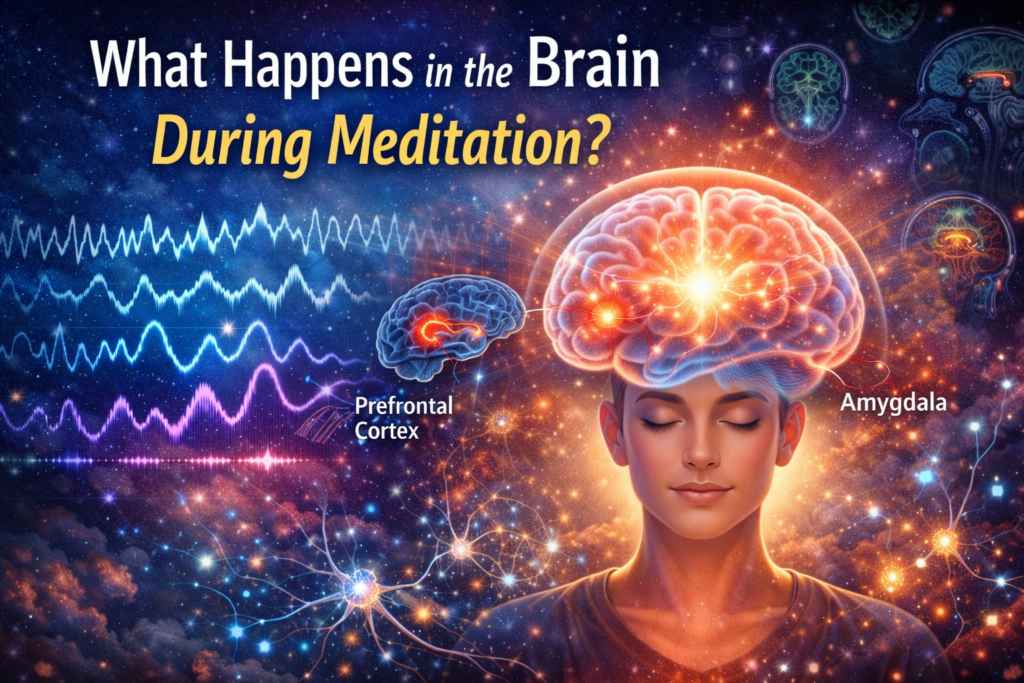
What happens in the brain during meditation? This question has fascinated scientists, spiritual teachers, and beginners alike. While meditation may look simple from the outside, powerful neurological changes begin inside your brain the moment you sit quietly and focus.
Modern neuroscience now shows that meditation physically changes brain activity, reduces stress responses, and improves focus.
Let’s explore what really happens inside your brain during meditation.
1️⃣ What Happens in the Brain During Meditation: Brain Waves Slow Down
Your brain operates in different wave patterns:
- Beta waves (normal waking state)
- Alpha waves (relaxed state)
- Theta waves (deep relaxation)
- Delta waves (deep sleep)
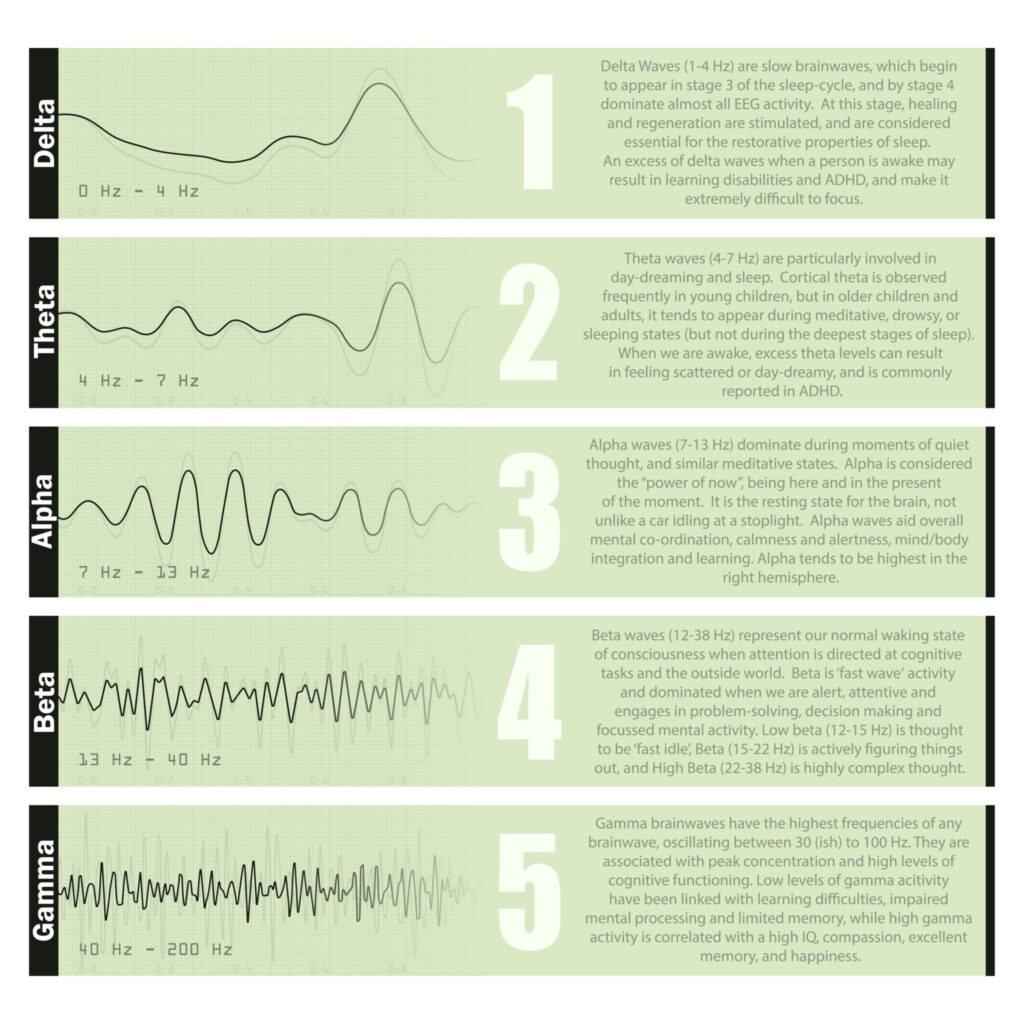
During meditation:
- Beta activity decreases
- Alpha waves increase
- Theta waves become more active
This shift explains why you feel calm, relaxed, and mentally clear after meditation.
It’s not imagination — it’s measurable brain activity.
2️⃣ What Happens in the Brain During Meditation: The Amygdala Shrinks
The amygdala is the part of your brain responsible for:
- Fear
- Stress
- Anxiety
- Fight-or-flight response
Studies show that regular meditation reduces activity in the amygdala.
Over time, it can even shrink in size.
This means:
You respond to stress more calmly.
You become less reactive.
You feel emotionally balanced.
3️⃣ What Happens in the Brain During Meditation: Prefrontal Cortex Strengthens
The prefrontal cortex controls:
- Decision making
- Focus
- Self-control
- Awareness
Meditation strengthens this area.
This is why people who meditate regularly experience:
- Better concentration
- Clear thinking
- Improved discipline
- More awareness of thoughts
4️⃣ Default Mode Network Becomes Quiet
There is a network in your brain called the Default Mode Network (DMN).
It activates when:
- You overthink
- You replay past memories
- You worry about the future
- Your mind wanders
Meditation reduces activity in the DMN.
This explains why meditation helps stop excessive thinking — something we discussed in our previous article on beginners struggling with thoughts.
Less DMN activity = less mental noise.
5️⃣ Gray Matter Increases
Long-term meditators show increased gray matter in areas related to:
- Emotional regulation
- Memory
- Compassion
- Self-awareness
This means meditation literally improves your brain structure.
It’s like going to the gym — but for your mind.
6️⃣ Stress Hormones Decrease
Meditation lowers cortisol — the stress hormone.
High cortisol leads to:
- Anxiety
- Fatigue
- Poor sleep
- Weak immunity
By reducing cortisol, meditation:
- Improves sleep
- Boosts immunity
- Enhances emotional stability
Is Meditation Just Psychological?
No, Brain scans clearly show physical changes.
Even 8 weeks of daily meditation practice can produce measurable differences.
This is why meditation is now used in:
- Hospitals
- Corporate environments
- Therapy programs
- Schools
It is no longer just a spiritual practice — it is neuroscience-backed.
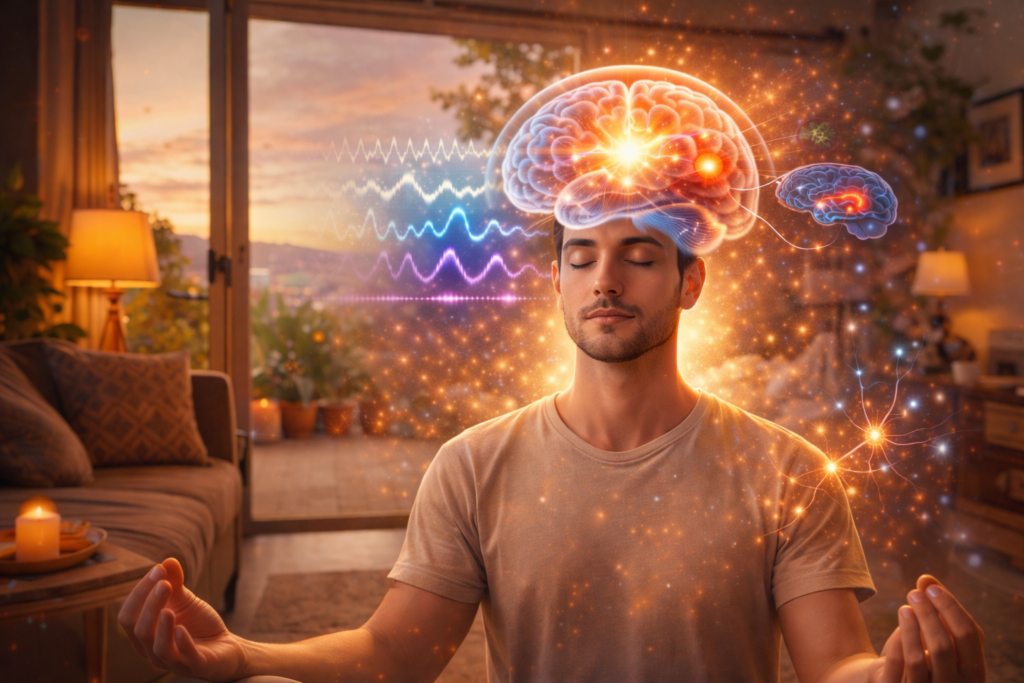
How Fast Do Brain Changes Happen?
Immediate effects:
- Calmness
- Reduced heart rate
- Slower breathing
Long-term effects:
- Structural brain changes
- Emotional resilience
- Better focus
- Reduced anxiety patterns
Consistency matters more than duration.
10 minutes daily is better than 1 hour once a week.
The Spiritual Connection
While science explains the “how,” spirituality explains the “experience.”
Science shows brain changes.
Spirituality shows consciousness expansion.
Both are pointing to the same truth:
Meditation transforms you from the inside.
Final Thoughts
Meditation is not about escaping thoughts.
It is about rewiring your brain to respond differently to them.
When practiced consistently:
- Your stress decreases.
- Your focus improves.
- Your awareness deepens.
- Your emotional reactions soften.
Meditation for Beginners: Your brain becomes calmer. Your life becomes clearer.
And that is where true transformation begins.

Pingback: Why Do We Fear Death? A Philosophical Explanation