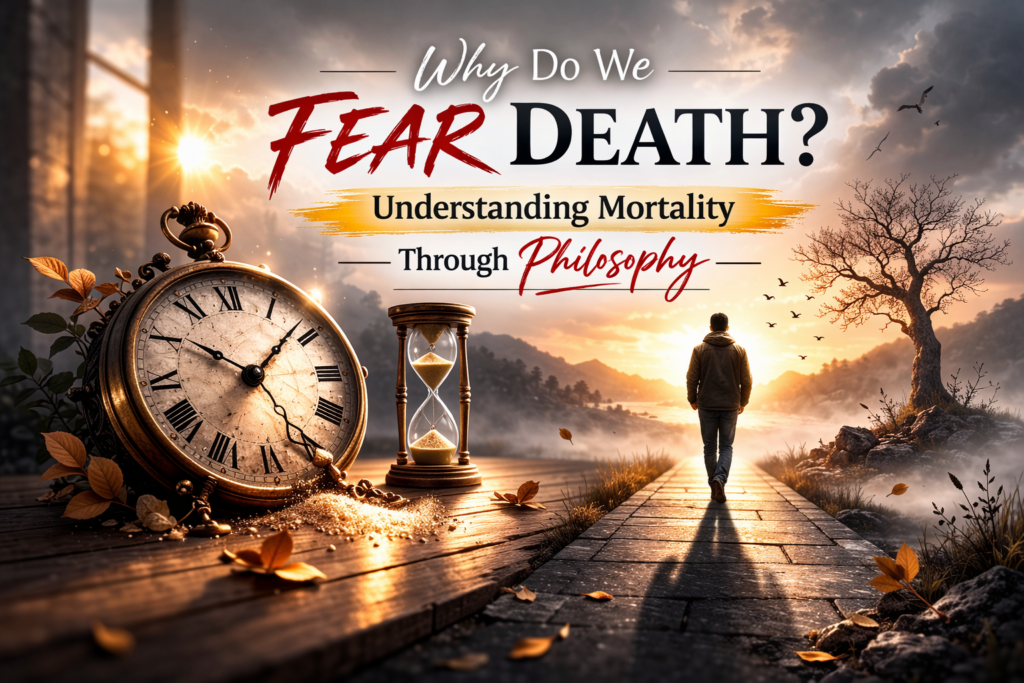
Why do we fear death? This question has troubled humanity for centuries. Although death is the only certainty in life, it remains one of our deepest fears. From ancient philosophers to modern psychologists, thinkers have tried to understand why the idea of death creates anxiety.
However, the fear of death is not simply about dying. Instead, it often reflects deeper concerns about identity, control, and the unknown.
Let us explore the psychological and philosophical roots behind this universal fear.
The Fear of the Unknown
One major reason why we fear death is uncertainty. Humans naturally seek stability and predictability. Death, however, represents complete uncertainty.
We do not know:
- What happens after death
- Whether consciousness continues
- How or when it will occur
Therefore, the mind reacts with anxiety. In philosophy, fear often arises when something cannot be understood or controlled.
The Fear of Losing Identity
Another powerful reason why we fear death is the potential loss of identity. We strongly identify with our body, memories, and personal story.
When we ask why do we fear death, we are often asking:
“What happens to me?”
If the self disappears, who are we without our name, achievements, and relationships?
This connects closely with identity. In fact, as discussed in our article on ego and identity, much of our suffering comes from attachment to the idea of “me.”
When the ego feels threatened, fear intensifies.
The Instinct for Survival
From a psychological perspective, fear of death is also biological. The human brain evolved to protect survival.
The amygdala, which processes fear, reacts strongly to threats. Consequently, even thinking about death can activate anxiety.
According to research published by Harvard Health, awareness of mortality can trigger stress responses in the brain.
Thus, part of the fear is natural and protective.
Fear of Losing Control
Humans prefer to feel in control. Death removes that illusion entirely.
No matter how successful, wealthy, or powerful someone becomes, death remains unavoidable.
Therefore, fear sometimes reflects the frustration of losing control rather than the event itself.
Philosophers such as the Stoics argued that suffering increases when we resist what we cannot control.
Cultural and Religious Influence
Cultural beliefs also shape how we experience fear.
For example:
- Some religions describe punishment after death.
- Others promise rebirth or liberation.
- Some modern views describe complete nothingness.
These narratives influence how comfortable or anxious people feel about mortality.
The Stanford Encyclopedia of Philosophy explains how different traditions approach death and the afterlife in distinct ways.
Is the Fear of Death Actually Fear of Not Living Fully?
Interestingly, many philosophers argue that the fear of death is actually regret about life.
We may fear:
- Unfulfilled dreams
- Unspoken words
- Missed opportunities
In this sense, the fear is not about death itself, but about unfinished living.
Existential philosophers like Martin Heidegger suggested that awareness of death can create deeper meaning in life.
Can Awareness Reduce Fear?
Meditation and philosophical reflection can soften this fear.
When individuals observe their thoughts rather than identify with them, anxiety decreases.
Practices that cultivate awareness help separate identity from the body and mental story. As a result, fear becomes less overwhelming.
Research published in Frontiers in Psychology suggests that mindfulness reduces anxiety related to mortality.
Thus, awareness does not eliminate death — but it transforms our relationship with it.
What Happens When We Accept Death?
Acceptance changes perspective.
Instead of resisting mortality, individuals who accept it often:
- Value time more deeply
- Strengthen relationships
- Focus on meaning
- Reduce unnecessary conflict
In contrast, denial can lead to constant background anxiety.
Paradoxically, accepting death can increase appreciation for life.
Although death is natural, it threatens our identity and sense of control. Therefore, the mind reacts defensively.
Yes. Some level of fear is biologically wired for survival. However, excessive anxiety can often be reduced through awareness.
No. Cultural and religious beliefs significantly influence how people view mortality.
Yes. Mindfulness practices help individuals observe thoughts without becoming overwhelmed by them.
Not at all. Fear of death is a universal human experience. The key is learning how to relate to it consciously.
Conclusion
So, why do we fear death?
We fear uncertainty.
We fear losing identity.
We fear losing control.
However, beneath all of these lies attachment — attachment to self, story, and permanence.
When awareness deepens, fear softens. Death remains inevitable, yet it no longer dominates the mind.
In fact, accepting mortality may be one of the most powerful ways to live fully.
If you would like to read a shorter overview of the concept, we have also shared a
If you would like to read a shorter overview of the concept, we have also shared a brief explanation of conscious living
